No Ideas, No Worries.

Ever get the “I don’t have any ideas!” student? Not the ones who do it once in a while, but the ones who try it every single day! Here are some ways to combat the “I will do anything in the entire world, including making myself sick to my stomach to have to go to the office, to get out of writing.”

1. Student Choice

One thing we are working on in my classroom currently is opinion writing. The objective is “I can write an opinion paragraph” This includes being able to state an opinion, use reasons to support an opinion, using linking words, and providing a concluding sentence. These are all learning targets in themselves that we develop over time to reach the over-arching “I can write an opinion paragraph.” As long as students fulfill the objective, I don’t care what they write about, as long as it’s school appropriate and second-grade appropriate.

This week students were able to choose between, “Are Trolls or Dragons Better?” and “Are Sharks or Dolphins Better?” Also, by making topics relevant and fun, you will get more writers. Of course, they want to write about trolls because of the movie, or dolphins or sharks cause animals are all the rage in second grade. We also wrote about “Are Unicorns or Narwhals Better” this week, mainly because unicorns are all we talk about in second grade, and we all know what narwhals are from MooseTube Go Noodle.

I always lay them out at a back table, and students who are quiet can go grab their choice first. I always make enough copies so that everyone gets their choice, and I always give them time at the end to share, or you get them talking about their choice the entire time to their neighbors instead of writing about it.

Here’s where I got some of the choice sheets from above. They are for 1st grade, but can be easily used in kindergarten or second grade. https://www.teacherspayteachers.com/Product/FREE-Writing-Prompts-Opinion-Writing-Picture-Prompts-3140513

For Elementary, middle school, and high school topics, you can always just google writing topics for your grade level or some can be found at

https://www.edutopia.org/article/50-writing-prompts-all-grade-levels-todd-finley.

2. Writing Notebook Decor

Have writing notebooks? You should! Then have students decorate the outside with pictures of places they have gone, photos of them with family, and pictures of memories. That way, when they say the infamous, “I have nothing to write about,” you point to a picture and say “How about you tell me about that?” They instantly want to start telling you about it, and then you say, “Nope, I don’t want to hear it, I want to read it!” Then walk away as they scramble to write as much as possible for you to learn a little about them.

It also helps to glue a topic list on the inside cover they can always refer to for topics, and have students write list at the beginning of the year of people, places, and things that matter to them that they can always use to generate ideas.

3. Authentic Writing

Publish a class book. Make the topics relevant to students. Have students connect to other students across the globe. Have parents come in to see presentations put on by students. There are millions of ways to motivate students to write. Make it important, and they will write.

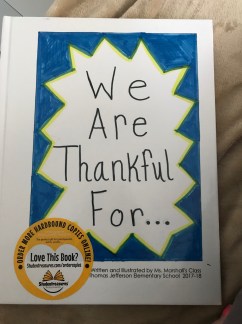
We use Student Treasures to publish our books or make your own class book with the binding at school.
IMG_3374

We write Flat Stanley letters to family members and friends and get them back with lots of neat information students share with the class. We had one go to Africa last year even, which led to us learning about endangered elephants with the souvenirs that were sent back. We also had one go to a city council member on accident in Kansas, but they did it for us anyway and sent a class book back to us and tons of information. We were even featured in their newsletter!


We did a career project where for informational writing, we learned about a career and put on a career fair for parents.


Here is our career fair writing fill-in-the-blank draft that is FREEhttps://www.teacherspayteachers.com/Product/Information-Writing-Career-Fair-Project-3539969

Make topics also authentic for students. “Should students have more recess?” Write a letter to the principal. “Should fidget spinners be allowed in school?” “Should there be more lunch options in the cafeteria.”

4. Fun Writing

My students have assigned teepee days, and on their day, they can write in the teepee. Do a write around the room that gets kids up and moving and learning new words.

Here is a Write Around the Room that is FREEhttps://www.teacherspayteachers.com/Product/Write-Around-the-Room-Freebie-387745

And if you don’t follow The Kindergarten Smorgasboard, you should. Here is an awesome source on write around the room. Even though I teach second, he is definitely part of my PLN. Follow him at @kindersmorgie  or on Facebook at https://www.facebook.com/kindergarten.smorgasboard.7/

Write The Room: https://thekindergartensmorgasboard.com/2017/08/write-the-room.html

5. Ask Questions

Oh, you don’t have a favorite food to describe using adjectives? How about you pick just one food you like? Oh, you don’t like anything? Then describe a food you don’t like.

Oh, you didn’t do anything over break? Not even sleep?

Oh, you don’t have a time when you were __________? Well I remember when you felt _______________ in our classroom when you were doing ___________________.

Oh, you hate writing? How about you write about how much you hate it?

You get the idea 😉

6. Freewriting and More

Ever hear of Freewrite Fridays? Ever let your students draw a picture to go with their final copy? Have students be able to write about what they want to write about. Have students write for 2-10 minutes depending on age about anything they want- it helps generate ideas. Show students that you write too!

I want to know, what ways do you inspire and motivate students to write in your classroom?
 

New Year, New Style!

I know it’s been A WHILE since I have posted, but there are a lot of neat things going on in our classroom! First, the fun stuff, then the free stuff! There’s pictures of our science project (I got lots of compliments when we did it last year), funny second grade responses on flip grid, and  lots of links to free resources, so make sure to scroll through the whole thing!)

Science (Stem) 

For the fun stuff, one fun thing we did this week was starting to make our 3 little pig houses! They can’t be blown down by the big bad wolf, and using what we know about properties of matter, we found out that flour and water makes the strongest mortar. We planned our houses. Here is a slideshow of our planning and what our houses look like right now. The lessons can be found at https://www.teacherspayteachers.com/Product/All-About-Matter-Aligns-with-NGSS-2-PS1-1234-and-K-2-ETS1-1-2-science-799909.

This slideshow requires JavaScript.

Flipgrid

Next, a Flipgrid update! We’ve been using Flipgrid for some pretty neat things!

l

Before, we used Padlet video to make videos to create problems for other students to solve. This week we used Flipgrid to show how to solve math problems. I also earned a new badge this week for 50 video responses!! I gave the students a choice between two problems. They picked which one they wanted to solve and recorded a video explaining the answer and how they got the answer. What a great way to assess!
Also, before Christmas we recorded videos on flip grid of our opinion writing of what we believed would be the worst Christmas present ever. Some of the answers included, “…Snakes because snakes make make me upset because they bite me. That’s not my style,” “…A meteor crashing because you would die when it hit your house and everyone would start freaking out and crying,” and the traditional “…Coal because it is boring, you can’t do anything with it, and you cannot even play with it.”

New Year, New Room

I took all the furniture out and put desk back in… Yeah, I know! All that hard work! We had a behaviorist come into our room before break, which led to a lot of changes. I have the perfect storm of students this year who I absolutely LOVE, but who also feed off each other all day long, try to get my attention in every single way possible, and have many different backgrounds, so this year is a little different than other years.

The first change was the seating. The second change is we have a cotton ball shop now! Students earn cotton balls throughout the day when they do what they are supposed to and do it respectfully. On Fridays, we have a cotton ball shop with parent volunteers. The students shop at the shop with the amount of their cotton balls. At the end of each day, we count our cotton balls, and we record the number, graph the number, and then all cotton balls are returned to the bins.

We also started using fun transition cards to help us transition. Some fun ones can be found at https://www.teacherspayteachers.com/Product/Transition-Cards-for-Between-Subjects-217142.

We use this for our cotton balls, and I just whited out the percentage signs, so students can graph by number. It’s also a great graph for students to graph scores with, and it’s FREE!! https://www.teacherspayteachers.com/Product/Data-Tracking-Graph-847624

My cotton ball tracker sheet is also FREE and EDITABLE (In case you don’t use cotton balls) and can be found at https://www.teacherspayteachers.com/Product/Positive-Behavior-Tracker-3584443.

Student Teachers, Podcast, Yoga, and “Meet The Teacher”

First off, congratulations to the student teachers who just graduated from college and second congratulations to those of you who will be starting your student teaching this winter. I’ve see lots of student teachers asking about introductions to students and parents.

I wanted to show you a couple examples of my letter to students and parents and give you some advice.

  1. Don’t be a perfectionist. This is advice that was passed down to me from my student teaching advisor. Be open to change and be positive and open-minded. Be adventurous and risk-taking, and do what you know is best and right for students… especially when you are a teacher.
  2. Be yourself. I was told this advice on Friday when meeting with a behavioral psychologist in my classroom that observed my kiddos. No matter what, your behavior management and classroom have to be your own and have to reflect you. I know when I am a very stressed teacher, I am the worst teacher. You will have tons of work during student teaching, but try to find something to help you de-stress, like yoga, shopping, going out with the girls/guys, or go to the gym.
  3. Listen to podcast. The Truth For Teachers is a great Podcast and so is the 10 minute teacher by Vicki Davis (She’s someone you should follow). “Finally Free: The Teacher Toolkit for Conquering Anxiety, Overwhelm, and the Pressure to do More” is a great resource for when you are a teacher. It’s found at https://www.teacherlifestylelab.com/p/finally-free. There is also free yoga for teachers and the classroom. Yoga with Adriene is my favorite. We use it in my classroom, and I use it at home! She is amazing!


 4. Have fun and listen to your cooperating teachers. They have great advice! You will rock it!

Here is a letter to parents from a student teacher example I created. https://www.teacherspayteachers.com/Product/Example-Letter-to-Parents-from-Student-Teacher-2016569

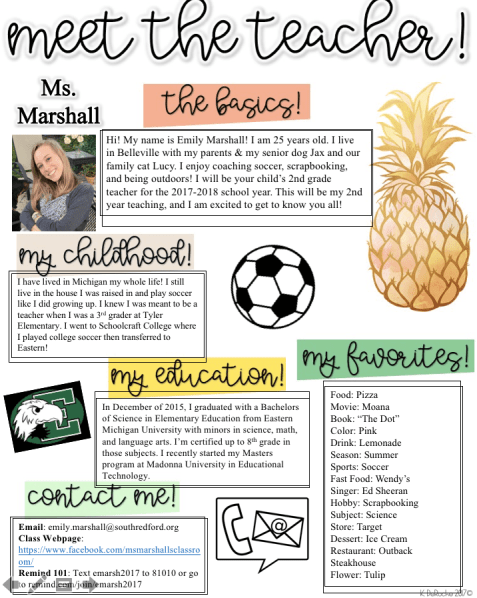
Kristi DeRoche has cute “Meet the Teacher” outlines online. Many are found at https://www.teacherspayteachers.com/Store/Kristi-Deroche. Thank’s Kristi for sharing your ideas with the world!

Here’s mine from using her outline:

Screen Shot 2017-12-16 at 7.10.40 PM


Cooperative Learning

On my last post, I showed how our class uses Padlet to work in groups,  but there are other ways we work cooperatively in our classroom. One thing this year that was implemented was a new reading program called Success For All, and it’s very similar to guided reading groups, except instead of small groups, everyone is at the same level in one room. One of the challenges is differentiating for developmentally appropriate levels because I have 4th, 3rd, and 2nd graders all in one room, but I’ve found some ways to help all the students with collaboration that work very well for collaboration and management. The ideas below can be implemented in any subject and/or with programs like SFA or like Kagan structures.

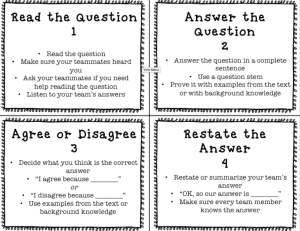
One thing we do is when we answer questions, we use role cards. Ones we use in our classroom are FREE by Teaching Expedition and located at https://www.teacherspayteachers.com/Product/Team-Talk-Role-Cards-3176289.

Screen Shot 2017-12-14 at 7.14.17 PM.png

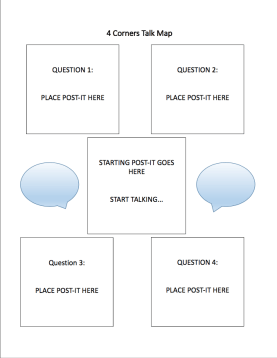
The next thing we do is use a talk map to answer the questions. Role cards rotate every question. The question students work on gets placed in the middle, and the teacher can see what question the students are on. When they are done with one question, they work on the next.

The sheet for questions we use is located on my teacherspayteachers page, and it’s also FREE! It’s at https://www.teacherspayteachers.com/Product/Discussion-Talk-Map-3540265.

Screen Shot 2017-12-14 at 7.11.00 PM


The Possibilities of Padlet

I’ve included 3 Padlet examples in this blog that I have created and shared to help other teachers come up with ideas to use Padlet. We’ve always used it for our Newsletter (if you don’t want to pay for SMORE). I started thinking of other ways to use it, and here are a few ways I have come up with!

First, I wanted to share what we have been doing in math using Padlet! If you have access to a computer lab or Chromebook, I recommend doing this with your students. It allows them to be creative, problem solvers, designers, and more. We worked in groups to create a classroom math Padlet. Although I took their videos down for the internet, they had to make a video for each problem they created. I left my videos on there for you to see. They had to write their problem (I edited them for you guys ;)) and then solve others’ problems.

Here’s the Padlet: https://padlet.com/emarshall321/5fco310kdjf9

Here’s how it worked:

Day 1: They came up with a group name (I did not tell them to do this; they all decided they wanted to do this on their own). Next, they created a problem with their group. The decided to use their teammates names in the problems, but I changed these also for privacy on the internet. After they created their problem, they made a video of themselves reading the problem. Since they all want to be YouTubers why not use that to your advantage? When they finished their video and were waiting for others, they could create more problems.

*My Padlet was password protected AND the student work had to be approved by me first before they would pop up on the Padlet.

Day 2: It was a centers day, so at my center, we solved the problems together. I was able to pick which problems I wanted each group to solve, so my lowest group, I could pick an easy, non-regrouping problem a group created to practice. For my highest group, I could pick challenging problems other students created for them to work on or was able to get through more problems and a variety of problems.

What’s Next?

Students will video themselves solving a problem. They’ll tell their answer and explain their answer as an exit ticket, and I will show some videos to the class to show different ways of solving a problem AND what it’s like to use words to share how you solve a problem. We will use this to practice agreeing or disagreeing respectfully.

Another way to use Padlet is for students to create a graphic organizer to remember topics or for you as the teacher to create organizers to explain information to students.

Here’s a Padlet for Parts of a Seed: https://padlet.com/emarshall321/y0vag5scnfe8

Here’s a KWL Padlet: https://padlet.com/emarshall321/kaqg14uvth37